The Basic Concept Behind Marugoto
Marugoto is based on the language syllabus known as the JF Standard for Japanese-Language Education (JFS), which was developed to put into practice a style of Japanese language education that fosters mutual understanding. Marugoto is characterized by the following key features:
"Can-Do" Objectives
The primary goal of Marugoto is to enable learners to actively participate in Japanese communication across a variety of real-life situations. Therefore, the learning objectives are set in the form of "Can-dos," which describe exactly what the learners can do using Japanese. Furthermore, the language structures and grammar taught in the course are specifically selected based on what is necessary to achieve these Can-do goals.
CEFR-Aligned Levels
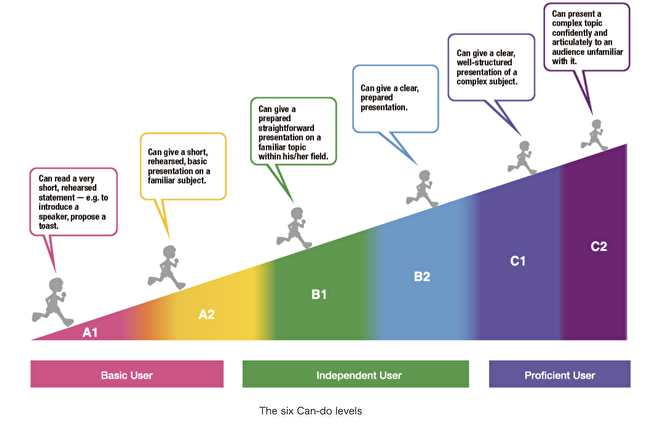
The levels of "Marugoto" correspond directly to the six levels of the Common European Framework of Reference for Languages (A1, A2, B1, B2, C1, and C2). The textbooks currently available in the series are:
Starter (A1)
Elementary 1 and 2 (A2)
Pre-Intermediate (A2/B1)
Intermediate 1 and 2 (B1)
Because the six levels of the JFS follow the exact same leveling system as the CEFR*, your Japanese language proficiency can be easily and internationally compared with your skills in other languages.
* CEFR is the abbreviation for the "Common European Framework of Reference for Languages: Learning, teaching, assessment".